Economy
Ireland is an open economy (6th on the Index of Economic Freedom), and ranks first for "high-value" foreign direct investment (FDI) flows. Using the metric global GDP per capita, Ireland ranks 5th of 187 (IMF) and 6th of 175 (World Bank). The alternative metric modified Gross National Income (GNI) is intended to give a more accurate view of "activity in the domestic economy". This is particularly relevant in Ireland 's small globalised economy, as GDP includes income from non-Irish owned companies, which flows out of Ireland. Indeed, foreign multinationals are the driver of Ireland's economy, employing a quarter of the private sector workforce, and paying 80% of Irish business taxes. 14 of Ireland's top 20 firms (by 2017 turnover) are US-based multinationals (80% of foreign multinationals in Ireland are from the US; there are no non-US/non-UK foreign firms in Ireland's top 50 firms by turnover, and only one by employees, that being German retailer Lidl at No. 41).
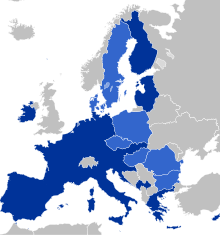
Ireland adopted the euro currency in 2002 along with eleven other EU member states.
The country officially exited recession in 2010, assisted by a growth in exports from US multinationals in Ireland. However, due to a rise in the cost of public borrowing due to government guarantees of private banking debt, the Irish government accepted an €85 billion programme of assistance from the EU, International Monetary Fund (IMF) and bilateral loans from the United Kingdom, Sweden and Denmark. Following three years of contraction, the economy grew by 0.7% in 2011 and 0.9% in 2012. The unemployment rate was 14.7% in 2012, including 18.5% among recent immigrants. In March 2016 the unemployment rate was reported by the CSO to be 8.6%, down from a peak unemployment rate of 15.1% in February 2012. In addition to unemployment, net emigration from Ireland between 2008 and 2013 totalled 120,100, or some 2.6% of the total population according to the Census of Ireland 2011. One-third of the emigrants were aged between 15 and 24.
Ireland exited its EU-IMF bailout programme on 15 December 2013. Having implemented budget cuts, reforms and sold assets, Ireland was again able to access debt markets. Since then, Ireland has been able to sell long term bonds at record rates. However, the stabilisation of the Irish credit bubble required a large transfer of debt from the private sector balance sheet (highest OECD leverage), to the public sector balance sheet (almost unleveraged, pre-crisis), via Irish bank bailouts and public deficit spending. The transfer of this debt means that Ireland, in 2017, still has one of the highest levels of both public sector indebtedness, and private sector indebtedness, in the EU-28/OECD.
Ireland continues to de-leverage its domestic private sector while growing its US multinational-driven economy. Ireland became the main destination for US corporate tax inversions from 2009–2016 (mostly pharmaceutical), peaking with the blocked $160bn Allergan/Pfizer inversion (world's largest inversion, and circa 85% of Irish GNI*). Ireland also became the largest foreign location for US "big cap" technology multinationals (i.e. Apple, Google, Microsoft, Facebook), which delivered a GDP growth rate of 26.3% (and GNP growth rate of 18.7%) in 2015. This growth was subsequently shown to be due to Apple restructuring its "double Irish" subsidiary (Apple Sales International, currently under threat of a €13bn EU "illegal state aid" fine for preferential tax treatment).
Taxation policy
Ireland's economy was transformed with the creation of a 10% low-tax "special economic zone", called the International Financial Services Centre (or "IFSC"), in 1987. In 1999, the entire country was effectively "turned into an IFSC" with the reduction of Irish corporation tax from 32% to 12.5% (the birth of Ireland's "low-tax" model). This accelerated Ireland's transition from a predominantly agricultural economy into a knowledge economy focused on attracting US multinationals from high-tech, life sciences, and financial services industries seeking to avail of Ireland's attractive corporate tax rates and unique corporate tax system.
The "multinational tax schemes" foreign firms use in Ireland materially distort Irish economic statistics. This reached a climax with the famous "leprechaun economics" GDP/GNP growth rates of 2015 (as Apple restructured its Irish subsidiaries in 2015). The Central Bank of Ireland introduced a new statistic, "modified GNI" (or GNI*), to remove these distortions. GNI* is 30% below GDP (or, GDP is 143% of GNI). As such, Ireland's GDP and GNP should no longer be used.
From the creation of the IFSC, the country experienced strong and sustained economic growth which fuelled a dramatic rise in Irish consumer borrowing and spending, and Irish construction and investment, which became known as the Celtic Tiger period. By 2007, Ireland had the highest private sector debt in the OECD with a household debt-to-disposable income ratio of 190%. Global capital markets, who had financed Ireland's build-up of debt in the Celtic Tiger period by enabling Irish banks to borrow in excess of the domestic deposit base (to over 180% at peak), withdrew support in the global financial crisis. Their withdrawal from the over-borrowed Irish credit system would precipitate a deep Irish property correction which would then lead to the collapse of the Irish banking system.
Ireland's successful "low-tax" economy opens it to accusations of being a "corporate tax haven", and led to it being "blacklisted". A 2017 study ranks Ireland as the 5th largest global Conduit OFC (conduits legally route funds to tax havens). A serious challenge is the passing of the US Tax Cuts and Jobs Act of 2017 (whose FDII and GILTI regimes target Ireland's "multinational tax schemes"). The EU's 2018 Digital Sales Tax (DST) (and desire for a CCCTB) is also seen as an attempt to restrict Irish "multinational tax schemes" by US technology firms.
Trade
Although multinational corporations dominate Ireland's export sector, exports from other sources also contribute significantly to the national income. The activities of multinational companies based in Ireland have made it one of the largest exporters of pharmaceutical agents, medical devices and software-related goods and services in the world. Ireland's exports also relate to the activities of large Irish companies (such as Ryanair, Kerry Group and Smurfit Kappa) and exports of mineral resources: Ireland is the seventh largest producer of zinc concentrates, and the twelfth largest producer of lead concentrates. The country also has significant deposits of gypsum, limestone, and smaller quantities of copper, silver, gold, barite, and dolomite. Tourism in Ireland contributes about 4% of GDP and is a significant source of employment.
Other goods exports include agri-food, cattle, beef, dairy products, and aluminum. Ireland's major imports include data processing equipment, chemicals, petroleum and petroleum products, textiles, and clothing. Financial services provided by multinational corporations based at the Irish Financial Services Centre also contribute to Irish exports. The difference between exports (€89.4 billion) and imports (€45.5 billion) resulted an annual trade surplus of €43.9 billion in 2010, which is the highest trade surplus relative to GDP achieved by any EU member state.
The EU is by far the country's largest trading partner, accounting for 57.9% of exports and 60.7% of imports. The United Kingdom is the most important trading partner within the EU, accounting for 15.4% of exports and 32.1% of imports. Outside the EU, the United States accounted for 23.2% of exports and 14.1% of imports in 2010.
Energy
ESB, Bord Gáis Energy and Airtricity are the three main electricity and gas suppliers in Ireland. There are 19.82 billion cubic metres of proven reserves of gas. Natural gas extraction previously occurred at the Kinsale Head until its exhaustion. The Corrib gas field was due to come on stream in 2013/14. In 2012, the Barryroe field was confirmed to have up to 1.6 billion barrels of oil in reserve, with between 160 and 600 million recoverable. That could provide for Ireland's entire energy needs for up to 13 years, when it is developed in 2015/16. There have been significant efforts to increase the use of renewable and sustainable forms of energy in Ireland, particularly in wind power, with 3,000 MegaWatts of wind farms being constructed, some for the purpose of export. The Sustainable Energy Authority of Ireland (SEAI) has estimated that 6.5% of Ireland's 2011 energy requirements were produced by renewable sources. The SEAI has also reported an increase in energy efficiency in Ireland with a 28% reduction in carbon emissions per house from 2005 to 2013.
Transport
The country's three main international airports at Dublin, Shannon and Cork serve many European and intercontinental routes with scheduled and chartered flights. The London to Dublin air route is the ninth busiest international air route in the world, and also the busiest international air route in Europe, with 14,500 flights between the two in 2017. In 2015, 4.5 million people took the route, at that time, the world's second-busiest. Aer Lingus is the flag carrier of Ireland, although Ryanair is the country's largest airline. Ryanair is Europe's largest low-cost carrier, the second largest in terms of passenger numbers, and the world's largest in terms of international passenger numbers.
Railway services are provided by Iarnród Éireann (Irish Rail), which operates all internal intercity, commuter and freight railway services in the country. Dublin is the centre of the network with two main stations, Heuston station and Connolly station, linking to the country's cities and main towns. The Enterprise service, which runs jointly with Northern Ireland Railways, connects Dublin and Belfast. The whole of Ireland's mainline network operates on track with a gauge of 5 ft 3 in (1,600 mm), which is unique in Europe and has resulted in distinct rolling stock designs. Dublin's public transport network includes the DART, Luas, Dublin Bus, and dublinbikes.
Motorways, national primary roads and national secondary roads are managed by Transport Infrastructure Ireland, while regional roads and local roads are managed by the local authorities in each of their respective areas. The road network is primarily focused on the capital, but motorways connect it to other major Irish cities including Cork, Limerick, Waterford and Galway.
Dublin is served by major infrastructure such as the East-Link and West-Link toll-bridges, as well as the Dublin Port Tunnel. The Jack Lynch Tunnel, under the River Lee in Cork, and the Limerick Tunnel, under the River Shannon, were two major projects outside Dublin.


Comments
Post a Comment