Politics
Ireland is a constitutional republic with a parliamentary system of government. The Oireachtas is the bicameral national parliament composed of the President of Ireland and the two Houses of the Oireachtas: Seanad Éireann (Senate) and Dáil Éireann (House of Representatives). Áras an Uachtaráin is the official residence of the President of Ireland, while the houses of the Oireachtas meet at Leinster House in Dublin.
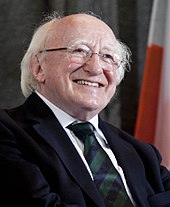
The President serves as head of state, is elected for a seven-year term, and may be re-elected once. The President is primarily a figurehead, but is entrusted with certain constitutional powers with the advice of the Council of State. The office has absolute discretion in some areas, such as referring a bill to the Supreme Court for a judgment on its constitutionality. Michael D. Higgins became the ninth President of Ireland on 11 November 2011.
The Taoiseach (Prime Minister) serves as the head of government and is appointed by the President upon the nomination of the Dáil. Most Taoisigh have served as the leader of the political party that gains the most seats in national elections. It has become customary for coalitions to form a government, as there has not been a single-party government since 1989. Micheál Martin succeeded Leo Varadkar as Taoiseach on 27 June 2020.
The Seanad is composed of sixty members, with eleven nominated by the Taoiseach, six elected by two universities, and 43 elected by public representatives from panels of candidates established on a vocational basis. The Dáil has 160 members (Teachtaí Dála) elected to represent multi-seat constituencies under the system of proportional representation and by means of the single transferable vote.
The Government is constitutionally limited to fifteen members. No more than two members can be selected from the Seanad, and the Taoiseach, Tánaiste (Deputy Prime Minister) and Minister for Finance must be members of the Dáil. The Dáil must be dissolved within five years after its first meeting following the previous election, and a general election for members of the Dáil must take place no later than thirty days after the dissolution. According to the Constitution of Ireland, parliamentary elections must be held at least every seven years, though a lower limit may be set by statute law. The current government is a coalition government composed of Fianna Fáil, Fine Gael, and the Green Party with Micheál Martin as Taoiseach and Leo Varadkar as Tánaiste. Opposition parties in the current Dáil are Sinn Féin, the Labour Party, Solidarity–People Before Profit, Social Democrats, Aontú, as well as a number of independents.
Ireland has been a member state of the European Union since 1973, but is not part of the Schengen Area. Citizens of the United Kingdom can freely enter the country without a passport due to the Common Travel Area, which is a passport-free zone comprising the islands of Ireland, Great Britain, the Isle of Man and the Channel Islands. However, some identification is required at airports and seaports.
Local government
The Local Government Act 1898 is the founding document of the present system of local government, while the Twentieth Amendment to the constitution of 1999 provided for its constitutional recognition. The twenty-six traditional counties of Ireland are not always coterminous with administrative divisions although they are generally used as a geographical frame of reference by the population of Ireland. The Local Government Reform Act 2014 provides for a system of thirty-one local authorities – twenty-six county councils, two city and county councils and three city councils. Below this (with the exception of the Dublin Region and the three city councils) are municipal districts, replacing a previous system of town councils.
|

Local authorities are responsible for matters such as planning, local roads, sanitation, and libraries. Dáil constituencies are required to follow county boundaries as much as possible. Counties with greater populations have multiple constituencies, some of more than one county, but generally do not cross county boundaries. The counties are grouped into eight regions, each with a Regional Authority composed of members delegated by the various county and city councils in the region. The regions do not have any direct administrative role as such, but they serve for planning, coordination and statistical purposes.
Law
Ireland has a common law legal system with a written constitution that provides for a parliamentary democracy. The court system consists of the Supreme Court, the Court of Appeal, the High Court, the Circuit Court and the District Court, all of which apply the Irish law and hear both civil and criminal matters. Trials for serious offences must usually be held before a jury. The High Court, Court of Appeal and the Supreme Court have authority, by means of judicial review, to determine the compatibility of laws and activities of other institutions of the state with the constitution and the law. Except in exceptional circumstances, court hearings must occur in public.
Garda Síochána na hÉireann (Guardians of the Peace of Ireland), more commonly referred to as the Gardaí, is the state's civilian police force. The force is responsible for all aspects of civil policing, both in terms of territory and infrastructure. It is headed by the Garda Commissioner, who is appointed by the Government. Most uniformed members do not routinely carry firearms. Standard policing is traditionally carried out by uniformed officers equipped only with a baton and pepper spray.
The Military Police is the corps of the Irish Army responsible for the provision of policing service personnel and providing a military police presence to forces while on exercise and deployment. In wartime, additional tasks include the provision of a traffic control organisation to allow rapid movement of military formations to their mission areas. Other wartime roles include control of prisoners of war and refugees.
Ireland's citizenship laws relate to "the island of Ireland", including islands and seas, thereby extending them to Northern Ireland, which is part of the United Kingdom. Therefore, anyone born in Northern Ireland who meets the requirements for being an Irish citizen, such as birth on the island of Ireland to an Irish or British citizen parent or a parent who is entitled to live in Northern Ireland or the Republic without restriction on their residency, may exercise an entitlement to Irish citizenship, such as an Irish passport.
Foreign relations
Foreign relations are substantially influenced by membership of the European Union, although bilateral relations with the United Kingdom and United States are also important. It held the Presidency of the Council of the European Union on six occasions, most recently from January to June 2013.
Ireland tends towards independence in foreign policy; thus the country is not a member of NATO and has a longstanding policy of military neutrality. This policy has led to the Irish Defence Forces contributing to peace-keeping missions with the United Nations since 1960, including during the Congo Crisis and subsequently in Cyprus, Lebanon and Bosnia and Herzegovina.
Despite Irish neutrality during World War II, Ireland had more than 50,000 participants in the war through enlistment in the British armed forces. During the Cold War, Irish military policy, while ostensibly neutral, was biased towards NATO. During the Cuban Missile Crisis, Seán Lemass authorised the search of Cuban and Czechoslovak aircraft passing through Shannon and passed the information to the CIA. Ireland's air facilities were used by the United States military for the delivery of military personnel involved in the 2003 invasion of Iraq through Shannon Airport. The airport had previously been used for the invasion of Afghanistan in 2001, as well as the First Gulf War.
Since 1999, Ireland has been a member of NATO's Partnership for Peace (PfP) program and NATO's Euro-Atlantic Partnership Council (EAPC), which is aimed at creating trust between NATO and other states in Europe and the former Soviet Union.
Military
Ireland is a neutral country, and has "triple-lock" rules governing the participation of Irish troops in conflict zones, whereby approval must be given by the UN, the Dáil and Government. Accordingly, its military role is limited to national self-defence and participation in United Nations peacekeeping.
The Defence Forces are made up of the Army, Naval Service, Air Corps and Reserve Defence Force. It is small but well equipped, with almost 10,000 full-time military personnel and over 2,000 in reserve. Daily deployments of the Defence Forces cover aid to civil power operations, protection and patrol of Irish territorial waters and EEZ by the Irish Naval Service, and UN, EU and PfP peace-keeping missions. By 1996, over 40,000 Irish service personnel had served in international UN peacekeeping missions.
The Irish Air Corps is the air component of the Defence Forces and operates sixteen fixed wing aircraft and eight helicopters. The Irish Naval Service is Ireland's navy, and operates eight patrol ships, and smaller numbers of inflatable boats and training vessels, and has armed boarding parties capable of seizing a ship and a special unit of frogmen. The military includes the Reserve Defence Forces (Army Reserve and Naval Service Reserve) for part-time reservists. Ireland's special forces include the Army Ranger Wing, which trains and operates with international special operations units. The President is the formal Supreme Commander of the Defence Forces, but in practice these Forces answer to the Government via the Minister for Defence.
In 2017, Ireland signed the United Nations Treaty on the Prohibition of Nuclear Weapons.


Comments
Post a Comment