Demographics

Genetic research suggests that the earliest settlers migrated from Iberia following the most recent ice age. After the Mesolithic, Neolithic and Bronze Age, migrants introduced a Celtic language and culture. Migrants from the two latter eras still represent the genetic heritage of most Irish people. Gaelic tradition expanded and became the dominant form over time. Irish people are a combination of Gaelic, Norse, Anglo-Norman, French, and British ancestry.
The population of Ireland stood at 4,588,252 in 2011, an increase of 8.2% since 2006. As of 2011update, Ireland had the highest birth rate in the European Union (16 births per 1,000 of population). In 2014, 36.3% of births were to unmarried women. Annual population growth rates exceeded 2% during the 2002–2006 intercensal period, which was attributed to high rates of natural increase and immigration. This rate declined somewhat during the subsequent 2006–2011 intercensal period, with an average annual percentage change of 1.6%. The total fertility rate (TFR) in 2017 was estimated at 1.80 children born per woman, below the replacement rate of 2.1, it remains considerably below the high of 4.2 children born per woman in 1850. In 2018 the median age of the Irish population was 37.1 years.
At the time of the 2016 census, the number of non-Irish nationals was recorded at 535,475. This represents a 2% decrease from the 2011 census figure of 544,357. The five largest sources of non-Irish nationals were Poland (122,515), the UK (103,113), Lithuania (36,552), Romania (29,186) and Latvia (19,933) respectively. Compared with 2011, the number of UK, Polish, Lithuanian and Latvian nationals fell. There were four new additions to the top ten largest non-Irish nationalities in 2016: Brazilian (13,640), Spanish (12,112), Italian (11,732), and French (11,661).
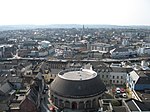
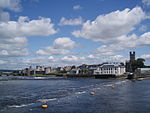
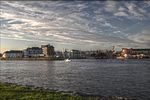
| Largest urban centres by population (2016 census) | |||||||
|---|---|---|---|---|---|---|---|
|
|
# | Settlement | Population | # | Settlement | Population |
|
| 1 | Dublin | 1,173,179 | 11 | Kilkenny | 26,512 | ||
| 2 | Cork | 208,669 | 12 | Ennis | 25,276 | ||
| 3 | Limerick | 94,192 | 13 | Carlow | 24,272 | ||
| 4 | Galway | 79,934 | 14 | Tralee | 23,691 | ||
| 5 | Waterford | 53,504 | 15 | Newbridge | 22,742 | ||
| 6 | Drogheda | 40,956 | 16 | Portlaoise | 22,050 | ||
| 7 | Swords | 39,248 | 17 | Balbriggan | 21,722 | ||
| 8 | Dundalk | 39,004 | 18 | Naas | 21,393 | ||
| 9 | Bray | 32,600 | 19 | Athlone | 21,349 | ||
| 10 | Navan | 30,173 | 20 | Mullingar | 20,928 | ||

Functional urban areas
The following is a list of functional urban areas in Ireland (as defined by the OECD) and their approximate populations as of 2015update.
| Functional urban areas | Approx. population 2015 |
|---|---|
| Dublin | 1,830,000 |
| Cork | 410,000 |
| Galway | 180,000 |
| Limerick | 160,000 |
| Waterford | 100,000 |
Languages
The Irish Constitution describes Irish as the "national language", but English is the dominant language. In the 2006 census, 39% of the population regarded themselves as competent in Irish. Irish is spoken as a community language only in a small number of rural areas mostly in the west and south of the country, collectively known as the Gaeltacht. Except in Gaeltacht regions, road signs are usually bilingual. Most public notices and print media are in English only. While the state is officially bilingual, citizens can often struggle to access state services in Irish and most government publications are not available in both languages, even though citizens have the right to deal with the state in Irish. Irish language media include the TV channel TG4, the radio station RTÉ Raidió na Gaeltachta and online newspaper Tuairisc.ie. In the Irish Defence Forces, all foot and arms drill commands are given in the Irish language.
As a result of immigration, Polish is the most widely spoken language in Ireland after English, with Irish as the third most spoken. Several other Central European languages (namely Czech, Hungarian and Slovak), as well as Baltic languages (Lithuanian and Latvian) are also spoken on a day-to-day basis. Other languages spoken in Ireland include Shelta, spoken by Irish Travellers, and a dialect of Scots is spoken by some Ulster Scots people in Donegal. Most secondary school students choose to learn one or two foreign languages. Languages available for the Junior Certificate and the Leaving Certificate include French, German, Italian and Spanish; Leaving Certificate students can also study Arabic, Japanese and Russian. Some secondary schools also offer Ancient Greek, Hebrew and Latin. The study of Irish is compulsory for Leaving Certificate students, but some may qualify for an exemption in some circumstances, such as learning difficulties or entering the country after age 11.
Healthcare
Healthcare in Ireland is provided by both public and private healthcare providers. The Minister for Health has responsibility for setting overall health service policy. Every resident of Ireland is entitled to receive health care through the public health care system, which is managed by the Health Service Executive and funded by general taxation. A person may be required to pay a subsidised fee for certain health care received; this depends on income, age, illness or disability. All maternity services are provided free of charge and children up to the age of 6 months. Emergency care is provided to patients who present to a hospital emergency department. However, visitors to emergency departments in non-emergency situations who are not referred by their GP may incur a fee of €100. In some circumstances this fee is not payable or may be waived.
Anyone holding a European Health Insurance Card is entitled to free maintenance and treatment in public beds in Health Service Executive and voluntary hospitals. Outpatient services are also provided for free. However, the majority of patients on median incomes or above are required to pay subsidised hospital charges. Private health insurance is available to the population for those who want to avail of it.
The average life expectancy in Ireland in 2016 was 81.8 years (OECD 2016 list), with 79.9 years for men and 83.6 years for women. It has the highest birth rate in the EU (16.8 births per 1,000 inhabitants, compared to an EU average of 10.7) and a very low infant mortality rate (3.5 per 1,000 live births). The Irish healthcare system ranked 13th out of 34 European countries in 2012 according to the European Health Consumer Index produced by Health Consumer Powerhouse. The same report ranked the Irish healthcare system as having the 8th best health outcomes but only the 21st most accessible system in Europe.
Education
Ireland has three levels of education: primary, secondary and higher education. The education systems are largely under the direction of the Government via the Minister for Education and Skills. Recognised primary and secondary schools must adhere to the curriculum established by the relevant authorities. Education is compulsory between the ages of six and fifteen years, and all children up to the age of eighteen must complete the first three years of secondary, including one sitting of the Junior Certificate examination.
There are approximately 3,300 primary schools in Ireland. The vast majority (92%) are under the patronage of the Catholic Church. Schools run by religious organisations, but receiving public money and recognition, cannot discriminate against pupils based upon religion or lack thereof. A sanctioned system of preference does exist, where students of a particular religion may be accepted before those who do not share the ethos of the school, in a case where a school's quota has already been reached.
The Leaving Certificate, which is taken after two years of study, is the final examination in the secondary school system. Those intending to pursue higher education normally take this examination, with access to third-level courses generally depending on results obtained from the best six subjects taken, on a competitive basis. Third-level education awards are conferred by at least 38 Higher Education Institutions – this includes the constituent or linked colleges of seven universities, plus other designated institutions of the Higher Education and Training Awards Council.
The Programme for International Student Assessment, coordinated by the OECD, currently ranks Ireland as having the fourth highest reading score, ninth highest science score and thirteenth highest mathematics score, among OECD countries, in its 2012 assessment. In 2012, Irish students aged 15 years had the second highest levels of reading literacy in the EU. Ireland also has 0.747 of the World's top 500 Universities per capita, which ranks the country in 8th place in the world. Primary, secondary and higher (university/college) level education are all free in Ireland for all EU citizens. There are charges to cover student services and examinations.
In addition, 37 percent of Ireland's population has a university or college degree, which is among the highest percentages in the world.
Religion
Religious freedom is constitutionally provided for in Ireland. Christianity is the predominant religion, and while Ireland remains a predominantly Catholic country, the percentage of the population who identified as Catholic on the census has fallen sharply from 84.2 percent in the 2011 census to 78.3 percent in the most recent 2016 census. Other results from the 2016 census are : 4.2% Protestant, 1.3% Orthodox, 1.3% as Muslim, and 9.8% as having no religion. According to a Georgetown University study, before 2000 the country had one of the highest rates of regular Mass attendance in the Western world. While daily attendance was 13% in 2006, there was a reduction in weekly attendance from 81% in 1990 to 48% in 2006, although the decline was reported as stabilising. In 2011, it was reported that weekly Mass attendance in Dublin was just 18%, with it being even lower among younger generations.
The Church of Ireland, at 2.7% of the population, is the second largest Christian denomination. Membership declined throughout the twentieth century, but experienced an increase early in the 21st century, as have other small Christian denominations. Other significant Protestant denominations are the Presbyterian Church and Methodist Church. Immigration has contributed to a growth in Hindu and Muslim populations. In percentage terms, Orthodox Christianity and Islam were the fastest growing religions, with increases of 100% and 70% respectively.
Ireland's patron saints are Saint Patrick, Saint Bridget and Saint Columba. Saint Patrick is the only one commonly recognised as the patron saint. Saint Patrick's Day is celebrated on 17 March in Ireland and abroad as the Irish national day, with parades and other celebrations.
As with other predominantly Catholic European states, Ireland underwent a period of legal secularisation in the late twentieth century. In 1972, the article of the Constitution naming specific religious groups was deleted by the Fifth Amendment in a referendum. Article 44 remains in the Constitution: "The State acknowledges that the homage of public worship is due to Almighty God. It shall hold His Name in reverence, and shall respect and honour religion." The article also establishes freedom of religion, prohibits endowment of any religion, prohibits the state from religious discrimination, and requires the state to treat religious and non-religious schools in a non-prejudicial manner.
Religious studies was introduced as an optional Junior Certificate subject in 2001. Although many schools are run by religious organisations, a secularist trend is occurring among younger generations.


Comments
Post a Comment